


Behind every piece of Mexican craftsmanship lies a material with its own unique history. The origin, extraction, and crafting of these materials are essential to the identity of each piece. In this guide, we explore three of the most iconic materials in Mexican artisan craft: black clay, Talavera, and traditional textiles.
1. Black clay: the art of Oaxaca
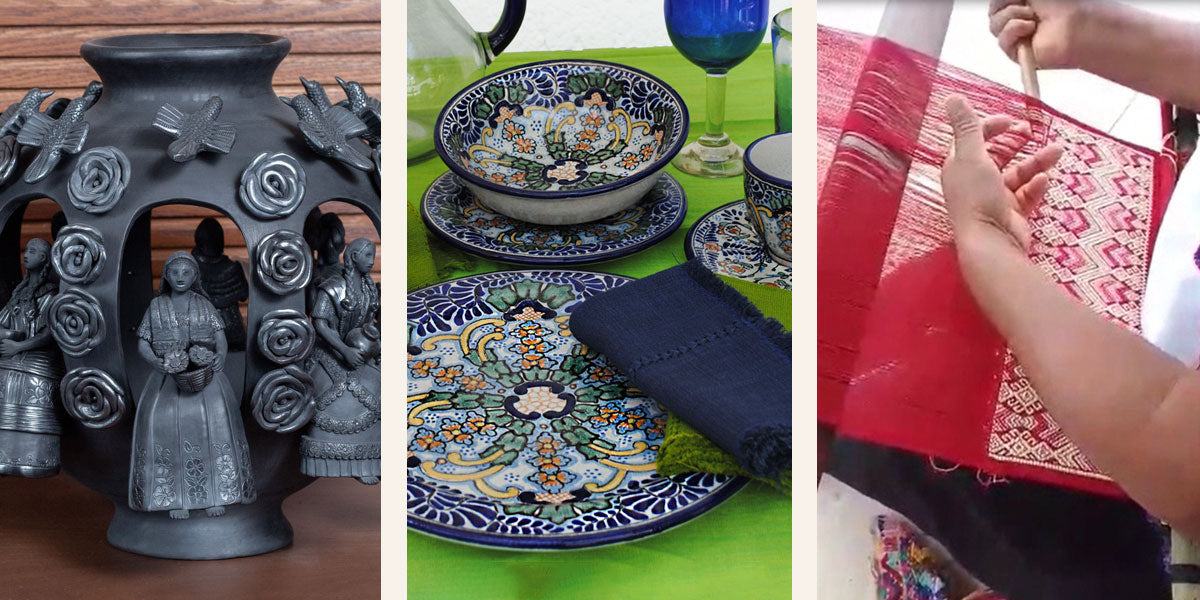
Black clay is characteristic of the San Bartolo Coyotepec region in Oaxaca's Central Valley. In its natural state, the clay used to create this pottery is not black but grayish; the color, metallic finish, and distinctive glossy surface are the result of a unique process.
Undeniable signs of authenticity
1. Sheen from quartz burnishing (not varnish): The glossy finish does not come from a plastic varnish; it is achieved by burnishing—rubbing the clay while it is in a "leather-hard" state with a quartz stone. This compacts the clay's pores, creating a natural shine without the need for vitreous glazes. To the touch and the eye, the sheen is silky and metallic, appearing integral to the surface rather than a superimposed outer layer.
2. Hand-cut openwork and symmetrical imperfections: In decorative openwork pieces, the cuts reveal small traces of the artisan's knife or hand-held cutting tool. The inner edges of the cutouts retain a dark tone, free from paint drips or marks left by industrial molds.
3. The piece's interior and base: Upon inspection of the interior or base, the black color is uniform yet displays deep grayish nuances or natural graphite tones. There is no flaking, buildup of layers, or odor of solvents.
4. Reduction firing: The key factor determining the color is the use of underground kilns (reduction kilns). Sealing the air intakes during firing creates an atmosphere saturated with carbon monoxide. The soot and lack of oxygen trigger a chemical reaction that transforms the iron oxides in the clay, setting the deep black tone.
Decorative uses: vases, figurines, candlesticks, plates, and sculptural pieces.
2. Talavera: Ceramics with Designation of Origin
Talavera is a type of glazed pottery of Hispano-Moorish origin that arrived in Mexico in the 16th century and merged with the indigenous pottery traditions of Puebla. Today, it holds a Designation of Origin status: only ceramics produced in Puebla and Tlaxcala using strictly traditional methods may be called "Talavera."
Key characteristics
1. Clay blend: The structural base consists of a proportional mixture of two local clay types: black clay (which provides plasticity) and white clay (which provides structural strength).
2. Tin-based glaze: After the initial firing (*jahuete*), the pieces are dipped in a glaze base that acts as a coating, creating the creamy, opaque white background upon which the hand-painting is done.
3. Natural mineral pigments: Decoration is executed exclusively using natural mineral oxides mixed with water; regulations authorize only six colors: cobalt blue, fine blue, yellow, green, black, and red-orange. Fluorescent tones or colors other than those mentioned indicate that the piece is not traditional Talavera.
4. Tactile relief from hand-painting: When the raw glaze is applied over the *jahuete* base and fired at high temperatures, the mineral pigments create a slight relief that can be felt when running one's fingers over the design.
5. Firing: Each piece undergoes two high-temperature kiln firings. The base (foot) of the piece is left unglazed to prevent it from sticking to the kiln during the second firing; this also allows the earthy tone of the regional clay blend to be seen. The final firing at temperatures exceeding 1000°C vitrifies the glaze and pigments, resulting in a durable, impermeable surface with a tactile texture that is resistant to fading from sunlight.
6. Certified by the Talavera Regulatory Council: Every authentic piece must bear the signature of the certified workshop, the artisan's monogram, and the holographic or engraved certification code on its unglazed base.
Authentic Talavera does not depreciate in value; it is a collectible piece that preserves community traditions.
Decorative uses: plates, cups, planters, tiles, lamps, and bathroom fixtures, among others.
3. Mexican Textiles: Threads with Memory
Mexican artisanal textiles represent one of the country's richest cultural heritages. From pre-Hispanic times to the present, these textiles have combined plant and animal fibers with advanced botanical and zoological knowledge used to create dyes. An artisanal *huipil*, *rebozo*, or rug is not a commercial fabric with a printed design, but rather a work of art constructed thread by thread. Each region boasts its own unique techniques, fibers, colors, and symbolism—for example:
- Backstrap loom: A pre-Hispanic technique used in Oaxaca, Chiapas, and Yucatán. It produces fabrics featuring highly precise geometric designs.
- Otomi embroidery: Originating in the Mezquital Valley of Hidalgo. It is characterized by vibrant animal and plant figures stitched onto unbleached cotton cloth (*manta*).
- *Huipil*: A traditional garment of the Maya and Zapotec cultures, woven on a backstrap loom with designs that identify the wearer's community of origin.
- *Rebozo*: A versatile garment woven on a treadle loom. Santa María del Río, in San Luis Potosí, is renowned as the *rebozo* capital.
Key elements of Mexican textiles
1. The texture of the iconography—brocade vs. industrial print: In loom weaving (whether backstrap or treadle), geometric motifs are integrated into the weave structure itself (brocade). When touched, the design has a raised texture, and the reverse side reflects the same structural logic—unlike the plain or blank back found in industrial prints.
2. The organic palette of natural dyes: Dyes extracted from cochineal, indigo, or tree bark produce nuanced, deep, and vivid tones that shift subtly with the light. They lack the flat or fluorescent sheen of industrial chemical dyes.
3. Fabric width and edge finishes: The width of fabrics made on a backstrap loom is limited by the artisan's hips or the loom's frame (typically ranging between 40 and 80 cm). They feature edges naturally closed by the weave, rather than scissor cuts finished by industrial machinery.
4. Slight variations in tension (the artisan's signature): Hand-woven garments display small, organic variations in yarn density. These "imperfections" are actually evidence of the manual tension adjusted by the weaver's own body.
Tools, base fibers, and natural dyes
1. Backstrap loom vs. treadle loom: The backstrap loom, of pre-Hispanic origin, allows the weaver to adjust tension using their body, making it ideal for high-density fabrics and complex brocades. The treadle loom, introduced by the Spanish, optimized production time for larger pieces such as blankets and *sarapes*.
2. Fibers: Native cotton (*Gossypium hirsutum*) has long been the quintessential plant fiber. Indigenous varieties like *coyuchi* provide natural shades ranging from cream to cinnamon-brown without the need for dyeing. Sheep's wool was introduced in the 16th century; it replaced or complemented the use of hard fibers in cold regions such as the highlands of Chiapas, Oaxaca, and the State of Mexico.
3. Organic pigments: Examples include cochineal (*Dactylopius coccus*), a parasite of the prickly pear cactus from which carminic acid is extracted to produce intense reds, purples, and pinks; indigo (*añil*), obtained by fermenting the leaves of the *Indigofera suffruticosa* plant, which provides blue tones; and purple snail dye, a marine dye sustainably harvested along the Oaxacan coast by Chontal and Huave weavers.
Viewing these pieces through the lens of their material origins allows us to appreciate their true value within the design and folk art markets, revealing that the price reflects not merely a garment, but months of technical craftsmanship, ancestral mathematical design, and environmental sustainability. Supporting artisanal textiles means preserving cultural diversity and fostering conscious consumption with a low environmental impact.
Why does it matter to know the material of your handcrafted piece?
At Tikal Arte Mexicano, we believe that knowing the material, technique, or region of origin of a handcrafted piece allows you to appreciate the work behind it, distinguish authentic pieces from industrial imitations, and make more informed purchasing decisions.